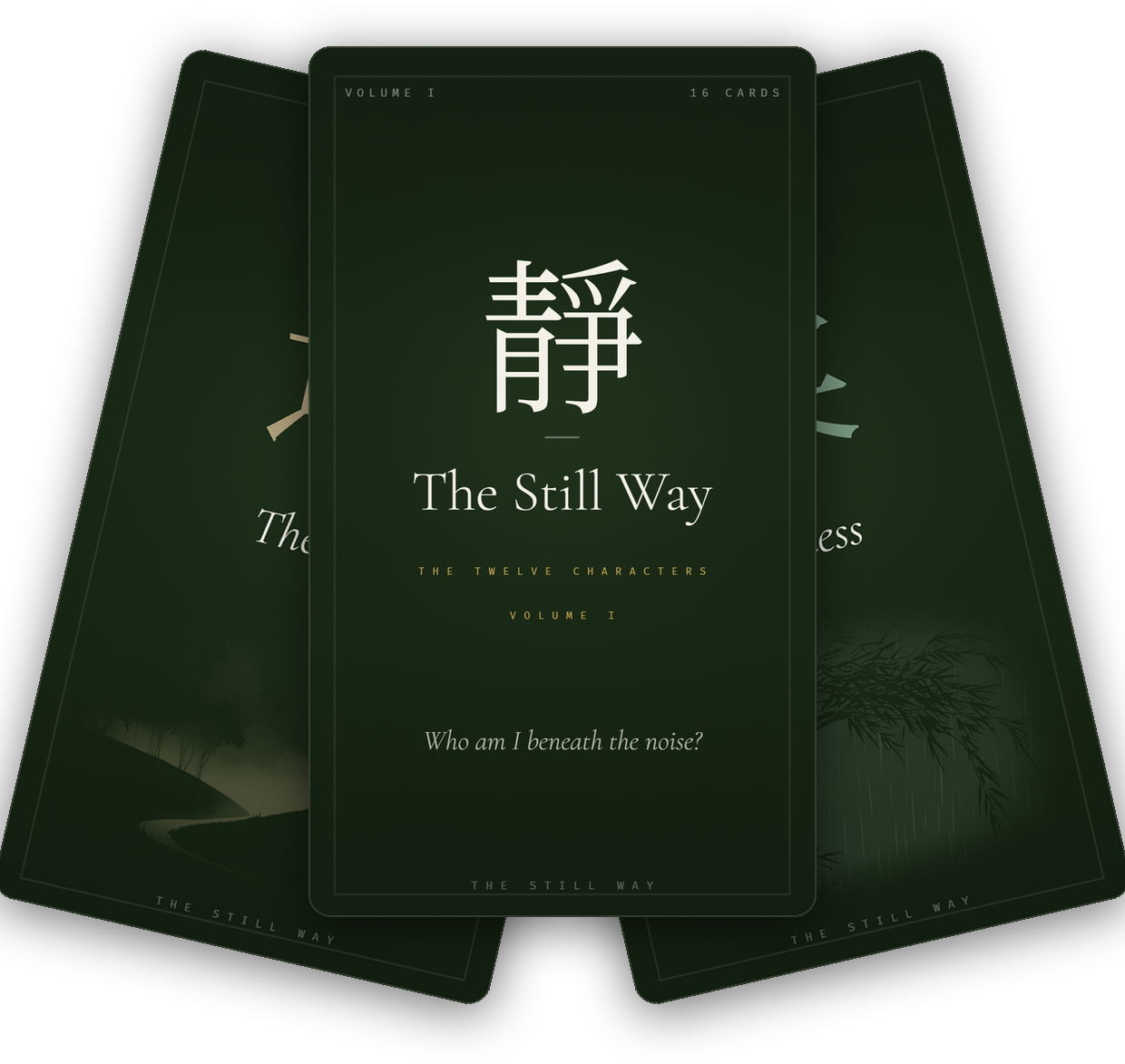
The Still Way · Volume I · 2026

The Still Way
Companion

A Taoist field guide for modern life. Twelve characters. Three parts. 2,500 years of wisdom translated into language for the life you are actually living.

12
Characters
123
Pages
3
Parts
I/III
Volume

Premium PDF · Read on any device · Print-ready A5 format

Who This Is For

The restlessness
has a name.

The Still Way Companion was written for people who have tried harder and found themselves more depleted, not less. People who sense that the problem is not personal - it is structural. A misalignment between how we have been taught to live and how living actually works. Taoism has been diagnosing this for 2,500 years.

You are exhausted by effort

Not from too much work - from too much forcing. The fatigue that sleep does not fix. The sense of rowing hard against a current you never chose to fight.

You cannot stop managing

Outcomes, perceptions, other people's emotions, your own image. The exhausting project of keeping everything under control - because somewhere you learned that releasing it was not safe.

You feel strangely misaligned

Capable, productive, and still slightly off-center. As if life is happening nearby rather than to you. A low hum of being pointed in a direction that is not quite yours.

You are full of the wrong things

Commitments, noise, stimulation, other people's urgency. No space to hear what is actually true for you. No room for what you cannot yet name.

Twelve Chapters

Three parts.
One complete map.

Each character is a lens. Each chapter is complete in itself - you can open the book anywhere. Together they form a full account of what Taoist living actually looks and feels like.

Part I - Foundations
Chapter I
Dào
The Way

The current beneath all things. The intelligence that runs the seasons without a plan and grows the seed without instruction.

FoundationOrigin
Chapter II
Inner Power

Your native virtue - not earned through moral effort but uncovered through the removal of what obscures it. What remains when performance stops.

IdentityAuthenticity
Chapter III
自然
Zìrán
Naturalness

Self-so. Spontaneous unfolding without contrivance. The antidote to the exhausting project of being someone other than what you already are.

EasePresence
Chapter IV
無為
Wú Wéi
Effortless Action

Action without forcing. Not laziness - the most sophisticated form of engagement. Swimming with the current rather than across it.

FlowNon-force
Part II - The Inner Landscape
Chapter V
Xīn
Heart-Mind

The word that refuses the Western split between thinking and feeling. The place from which you perceive - before opinion, before judgment, before the story begins.

AwarenessPerception
Chapter VI
Emptiness

The useful void. The hollow of the bowl that makes it useful. The silence that gives music its shape. What a fully scheduled life cannot contain.

SpaceReceptivity
Chapter VII
Jìng
Stillness

Not the absence of movement but the ground from which movement becomes legible. The still water that shows your reflection. The paused mind that hears what matters.

ClarityGrounding
Chapter VIII
Life Force

The animating energy in all living systems. Not metaphysical speculation - a practical map of what depletes and what restores. Forcing empties it. Yielding returns it.

EnergyVitality
Part III - Living the Way
Chapter IX
Shuǐ
Water

Lao Tzu's supreme metaphor. Takes the shape of its container. Seeks the lowest place. And yet nothing in the world overcomes it. The most yielding thing is the most persistent.

PersistenceFlow
Chapter X
Róu
Softness

The quality of living things. What survives the storm. The world calls it weakness - Taoism calls it the deepest structural intelligence available to a human being.

YieldingResilience
Chapter XI
Compassion

The first of Lao Tzu's three treasures. Not sentiment or softness for its own sake - a structural force that makes lasting action possible. The root of courage.

CompassionCourage
Chapter XII
Jiǎn
Simplicity

Not aesthetic minimalism - radical sufficiency. The art of removing what does not serve what matters. The discipline of not adding more when what is present is already enough.

SimplicityClarity

This is not a book to finish. It is a book to return to when life becomes noisy again.

The Still Way Companion · Volume I
Inside the Companion

Three formats.
One structure.

Each of the twelve chapters follows the same arc - from essence to essay to practice. You can read deeply or open to any single section. Each part works on its own.

Chapter cover
Part III · Chapter 10
Róu
Softness
Essay and essence
Essence

柔 is softness, but it is not weakness. It is suppleness, flexibility, the yielding that bends without breaking.

Reflection
· 82 ·
Practice section
The Softening
Finding where you have hardened, and letting it go
01
02
03
· 88 ·
How to Read It

Not a course.
A companion.

There is no right way to move through this book. Four approaches, each designed for a different moment.

Method I
Open anywhere

This is not a linear book. Each chapter is complete in itself. Open to a character that calls you, or let the book fall open at random. The Tao Te Ching was not meant to be read front to back either.

Method II
Follow the friction

Notice which characters produce resistance in you. That is the starting point. If 柔 (softness) makes you impatient, that is your invitation. The character you least want is usually the one you most need.

Method III
Return, don't complete

This is not a book to finish. It is a book to return to when life becomes noisy again. Each reading will offer something different - because you are different each time you return.

Method IV
Practice slowly

Each chapter ends with one practice. Do not do all twelve at once. Choose one character, sit with its practice for a week. Taoism is not a philosophy to understand - it is a way to inhabit.

Begin with the character
you need most.

No prior knowledge required. Only willingness to slow down long enough to look. The Still Way Companion - Volume I of III.

Get the Companion €19

Premium PDF · A5 format · Read on any device · Print-ready

Questions

A few things
worth knowing.

Do I need to know anything about Taoism before reading this?

No. The Companion was written for people who have never encountered Taoism and for people who have been reading it for years. The essays do not assume prior knowledge - they begin with the character as a concept and build from there. Every Chinese term is explained in plain language.

What format does it come in?

The Companion is a premium PDF in A5 format. It reads beautifully on a tablet or phone, and it is designed to be printed - the layout, margins, and typography are all print-optimized. After purchase via Gumroad you receive an instant download link.

What is Volume I of III?

The Still Way Companion will be a three-volume series, each covering a distinct set of principles. Volume I covers the twelve foundational characters - the ones that form the core philosophical vocabulary of Taoist living. Volumes II and III are in development.

How long does each chapter take to read?

A chapter takes around 15 to 20 minutes to read fully. The practice at the end of each chapter takes as long as you give it - anywhere from five minutes to an hour. The book is designed to be picked up and put down, not read in a single sitting.

Is there a print edition?

A print edition via Lulu is available. The PDF is print-ready if you prefer to print at home or through a local printer in A5 format. The digital edition on Gumroad is the primary version and is available immediately on purchase.